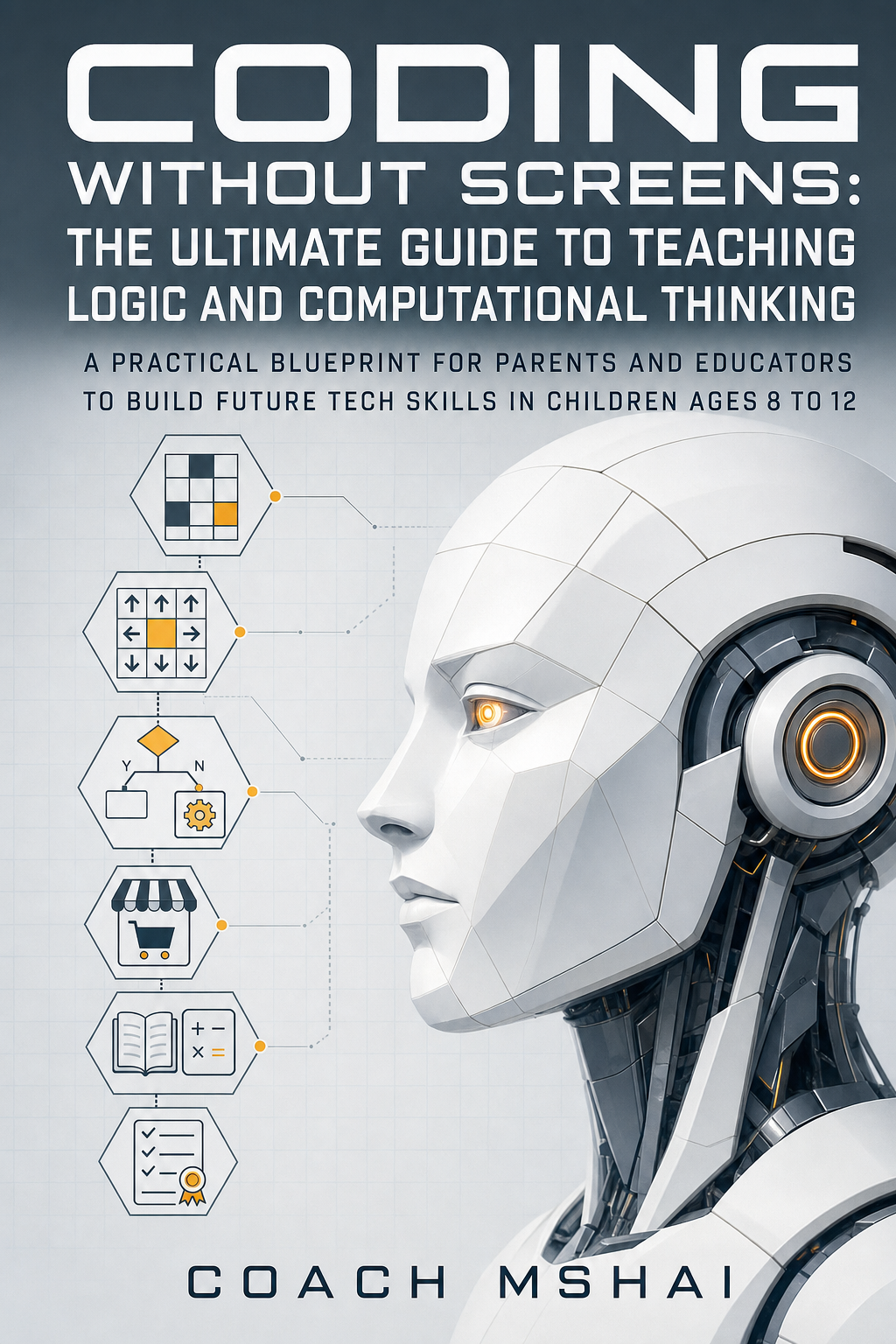
Coding Without Screens (Bundled With Workbooks)
📦 Includes: PDF · EPUB · Coding Activity Workbook · Coding Activity Answer Key
About this book
What if children could learn to think like coders, before ever touching a screen?
In a technology-driven world, coding education doesn't have to begin with a computer. Coding Without Screens: The Ultimate Guide to Teaching Logic and Computational Thinking provides parents and educators with a practical blueprint for teaching children ages 8–12 the foundational thinking skills behind computer science through hands-on, screen-free activities.
Using paper, pencils, grids, arrows, physical manipulatives, and interactive printables, children learn to:
Break complex problems into manageable steps
Recognize patterns and relationships
Build precise sequences and algorithms
Navigate logic grids and constrained environments
Understand if-then conditionals and decision-making
Debug mistakes through systematic investigation
Develop persistence, critical thinking, and problem-solving skills
Apply computational thinking across subjects and everyday situations
But this book goes beyond teaching children how to solve puzzles. It helps them develop a coder's mindset, where mistakes become useful information, problems become puzzles, and curiosity drives learning.
For parents and educators, the guide also explores how to assess progress without digital tools, adapt activities for diverse learners, integrate computational thinking into core subjects, and create professional educational resources for wider use.
The goal isn't simply to produce programmers. It is to develop thinkers, creators, and problem-solvers who understand the logic behind technology rather than merely consuming it.
Give children the foundation to move from passive technology users to active creators, one logical step at a time.